Build 25 Unique Backlinks to Your Pages Every Single Day for Free - Building backlinks to your pages is an essential part of SEO (short for Search Engine Optimization) for two reasons. The first reason is that it helps your pages get indexed faster, which is very important because you want the search engines to find them as soon as possible and crawl them regularly. The second reason is that it helps your pages get higher search engine rankings for the keywords of your choice. The more backlinks you have, the better. Period.
However, building backlinks can be a time-consuming, boring process. You can outsource the process to an agency and pay a lot of money... Or you can do it yourself with SocialMonkee! SocialMonkee is an instant backlink builder allowing you to build 25 unique backlinks, every day, FREE! All links are on unique C-Class IP addresses and domains. Imagine being able to create 25 unique backlinks every day, with the click of a button, FREE! Well, you can stop imagining...
Build 25 Unique Backlinks to Your Pages Every Single Day for Free
So, 25 unique backlinks every day... That's a total of 175 backlinks every week, 750 every month. If you upgrade, you will be able to build 100 uniques backlinks, 3 times a day! That's a total of 2,100 backlinks every week, 9,000 every month! The good news is... you can get a Premium Account, FREE! All you need to do is to refer 12 members, and your account will automatically be upgraded. If you're not really into referral marketing, you may upgrade right now for a low one-time fee.
Submitting a page to SocialMonkee via the members area takes under two minutes, but there's an even faster way! They created a Firefox plugin that allows you to submit your page to up to 100 sites in just a few clicks, using nothing else than Firefox! If you have a Premium Account you will also get access to link reports and RSS feeds, which are great to keep track of your backlinks and get them indexed fast. Submitting your RSS feeds to RSS submitters is actually a very important step in link building.
So what are you waiting for? Join SocialMonkee now while it's still free! And get 25 Unique Backlinks to Your Pages Every Single Day for Free on http://www.socialmonkee.com/index.php?af=14061 .
source : http://www.socialmonkee.com
Showing posts with label blogging. Show all posts
Showing posts with label blogging. Show all posts
Friday, February 25, 2011

Friday, January 21, 2011
How to Speed up Blogspot Loading Time
You have to admit, most free 3rd party Blogger Templates that you download are a mess. You open up the xml file and it’s a long and ugly-looking beast of code spaghetti. If you’re like me, you prefer a nice and neat template (even though you’ll be the only one seeing it) and you’ll want to tidy it up.
Most of the code you don’t want to tinker with but the .css code (the part that styles your entire blog with images and colors) is where some people like to change font colors, sizes, or even just space it out properly so it’s important that it’s not only neatly organized, but also properly aligned.
More importantly, did you know the more lines of code your template has, the longer it takes to load in a browser? So your 1,500 lines of code in your newest Blogger template could really be much shorter in size, thus speeding up page load times for your visitors. The slower your site, the more likely a visitor will be deterred and not wait for it to load up.
So here’s a neat trick to optimize your template. You’ll want to do what’s called “commpress your css” into a much smaller format. There’s a site I use called CSSDrive that offers a free web-based CSS Compressor. All you do is select a few basic options like compression mode and comments handling and then paste in your css. The css is the code between the <b:skin> and </b:skin> tags.
Make sure you backup your template code before doing this!
Some people might not like how the css looks after it’s compressed so it’s best to have a backup. You also might make a mistake and copy the wrong sections which could screw up your template code. Bottom-line, backup your template before doing this.
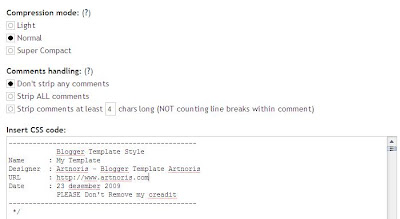
After you click on the “Compress-it!” button it will go through your .css code and shrinks it down. Essentially it removes unnecessary white spaces and better organizes each css element into one line. Here are the results for one of the Blogger templates I compressed.
 My xml Blogger template was originally size 47458 bytes and after the css compression was done, it dropped it down to 34276 bytes. Now that’s not a huge difference (28%) and you probably won’t notice a difference when you load up your blog with the new code, but every little bit helps. Also, some template code might be messier than others so the size decrease could potentially be a lot more.
I also just run the normal compression mode and wanted to keep my comments so if you go with the super compact mode and strip out all comments, you can compress it even further.
Source : http://artnoris.blogspot.com/2010/01/speed-up-blogger-page-load-time.html
Most of the code you don’t want to tinker with but the .css code (the part that styles your entire blog with images and colors) is where some people like to change font colors, sizes, or even just space it out properly so it’s important that it’s not only neatly organized, but also properly aligned.
More importantly, did you know the more lines of code your template has, the longer it takes to load in a browser? So your 1,500 lines of code in your newest Blogger template could really be much shorter in size, thus speeding up page load times for your visitors. The slower your site, the more likely a visitor will be deterred and not wait for it to load up.
So here’s a neat trick to optimize your template. You’ll want to do what’s called “commpress your css” into a much smaller format. There’s a site I use called CSSDrive that offers a free web-based CSS Compressor. All you do is select a few basic options like compression mode and comments handling and then paste in your css. The css is the code between the <b:skin> and </b:skin> tags.
Make sure you backup your template code before doing this!
Some people might not like how the css looks after it’s compressed so it’s best to have a backup. You also might make a mistake and copy the wrong sections which could screw up your template code. Bottom-line, backup your template before doing this.

After you click on the “Compress-it!” button it will go through your .css code and shrinks it down. Essentially it removes unnecessary white spaces and better organizes each css element into one line. Here are the results for one of the Blogger templates I compressed.

I also just run the normal compression mode and wanted to keep my comments so if you go with the super compact mode and strip out all comments, you can compress it even further.
Source : http://artnoris.blogspot.com/2010/01/speed-up-blogger-page-load-time.html
Friday, April 9, 2010
May cover and blog solidarity...
Artist Mark Braithwaite appears on the cover of the May issue of Artists and Illustrators magazine, which I shot last month in Mark's studio in York. On Monday April 12 I'll be heading to South London to shoot another feature for Artists and Illustrators, along with a video to show the readers, as blogged about by Editor Steve Pill at the Artists and Illustrators blog.
May cover and blog solidarity...
Artist Mark Braithwaite appears on the cover of the May issue of Artists and Illustrators magazine, which I shot last month in Mark's studio in York. On Monday April 12 I'll be heading to South London to shoot another feature for Artists and Illustrators, along with a video to show the readers, as blogged about by Editor Steve Pill at the Artists and Illustrators blog.
Sunday, March 21, 2010
Adakah Sitemap Untuk Blogspot?
Cara bikin Sitemap Blogspot
Bagi yg belum tau apa itu sitemap, bisa membaca apa itu sitemaps. Disana dijelaskan kalau guna sitemaps itu memudahkan google mengindex blog kita. Iya cara ini membantu siapa saja yg tertarik memudahkan google memasukkan konten blog kita ke database
Bila menggunakan wordpress, kita bisa memakai plugin google sitemap. Plugin ini bisa menyusun seluruh posting kita ke dalam file sitemap.xml khusus yg bisa lagsung diindex bot search engine mana pun. Akan tetapi bagaimana bikin sitemap bila blognya blogger.com dan bukannya wordpress ?
Berikut ini adalah 2 cara memasukkan sitemap blogspot kita ke google webmaster.
1. Masukkin http ://xxx.blogspot.com/atom.xml
2. Atau gunakan link http ://xxx.blogspot.com/rss.xml
Bila sudah disubmit, 2 Url diatas akan menjadi sitemap sehingga google bisa langsung memasukkan konten blog kita. Namun ada sedikit keanehan yg menambah keraguan. Ternyata kedua url itu cuma total url kedua file tsb cuma 26 buah. Hal ini membuat sy bertanya bagaimana nasib ratusan posting saya yg lain ?
Catatan Blogspot
Tolong dicatat kalau blog baru tetap saja membutuhkan waktu untuk diindex. Hal ini berbeda dengan blog yg sudah lama, mungkin berusia lebih dari sebulan dan rutin memposting konten.
Bahkan sering kali ada blog blogspot yg cuma butuh sejam setelah memposting konten untuk diindex google sekalipun tidak memiliki sitemap. Jadi, menimbulkan pertanyaan apakah blogspot kita butuh sitemap ?
Oh, iya, ada juga pendapat yg mengatakan kalau blogspot itu tidak membutuhkan sitemap. Alasan pendapat ini dikarenakan blogspot itu kan dari blogger.com yg merupakan layanan google. Apalagi google akan otomatis mengcrawl situs blogspot kita demi mempersegar index database mereka. (sumber : Bakwan)
Bagi yg belum tau apa itu sitemap, bisa membaca apa itu sitemaps. Disana dijelaskan kalau guna sitemaps itu memudahkan google mengindex blog kita. Iya cara ini membantu siapa saja yg tertarik memudahkan google memasukkan konten blog kita ke database
Bila menggunakan wordpress, kita bisa memakai plugin google sitemap. Plugin ini bisa menyusun seluruh posting kita ke dalam file sitemap.xml khusus yg bisa lagsung diindex bot search engine mana pun. Akan tetapi bagaimana bikin sitemap bila blognya blogger.com dan bukannya wordpress ?
Berikut ini adalah 2 cara memasukkan sitemap blogspot kita ke google webmaster.
1. Masukkin http ://xxx.blogspot.com/atom.xml
2. Atau gunakan link http ://xxx.blogspot.com/rss.xml
Bila sudah disubmit, 2 Url diatas akan menjadi sitemap sehingga google bisa langsung memasukkan konten blog kita. Namun ada sedikit keanehan yg menambah keraguan. Ternyata kedua url itu cuma total url kedua file tsb cuma 26 buah. Hal ini membuat sy bertanya bagaimana nasib ratusan posting saya yg lain ?
Catatan Blogspot
Tolong dicatat kalau blog baru tetap saja membutuhkan waktu untuk diindex. Hal ini berbeda dengan blog yg sudah lama, mungkin berusia lebih dari sebulan dan rutin memposting konten.
Bahkan sering kali ada blog blogspot yg cuma butuh sejam setelah memposting konten untuk diindex google sekalipun tidak memiliki sitemap. Jadi, menimbulkan pertanyaan apakah blogspot kita butuh sitemap ?
Oh, iya, ada juga pendapat yg mengatakan kalau blogspot itu tidak membutuhkan sitemap. Alasan pendapat ini dikarenakan blogspot itu kan dari blogger.com yg merupakan layanan google. Apalagi google akan otomatis mengcrawl situs blogspot kita demi mempersegar index database mereka. (sumber : Bakwan)
Lagi Males Nulis, gara-gara keasyikan optimasi, artikelku yang buat event SEO Sebar Iklan Baris Gratis Radhityanotes.com ditendang ama Mbah Google dan masuk Sandbox, makanya biar ada update, aku copas aja dolo sementara.
Monday, October 12, 2009
Subscribe to:
Posts (Atom)